Take its first steps
Explore a short, controlled walk on flat surfaces. Balance, stopping and recovery are studied first in a prepared environment.
ConceptAI mini biped robot
Small. Curious. On the move.
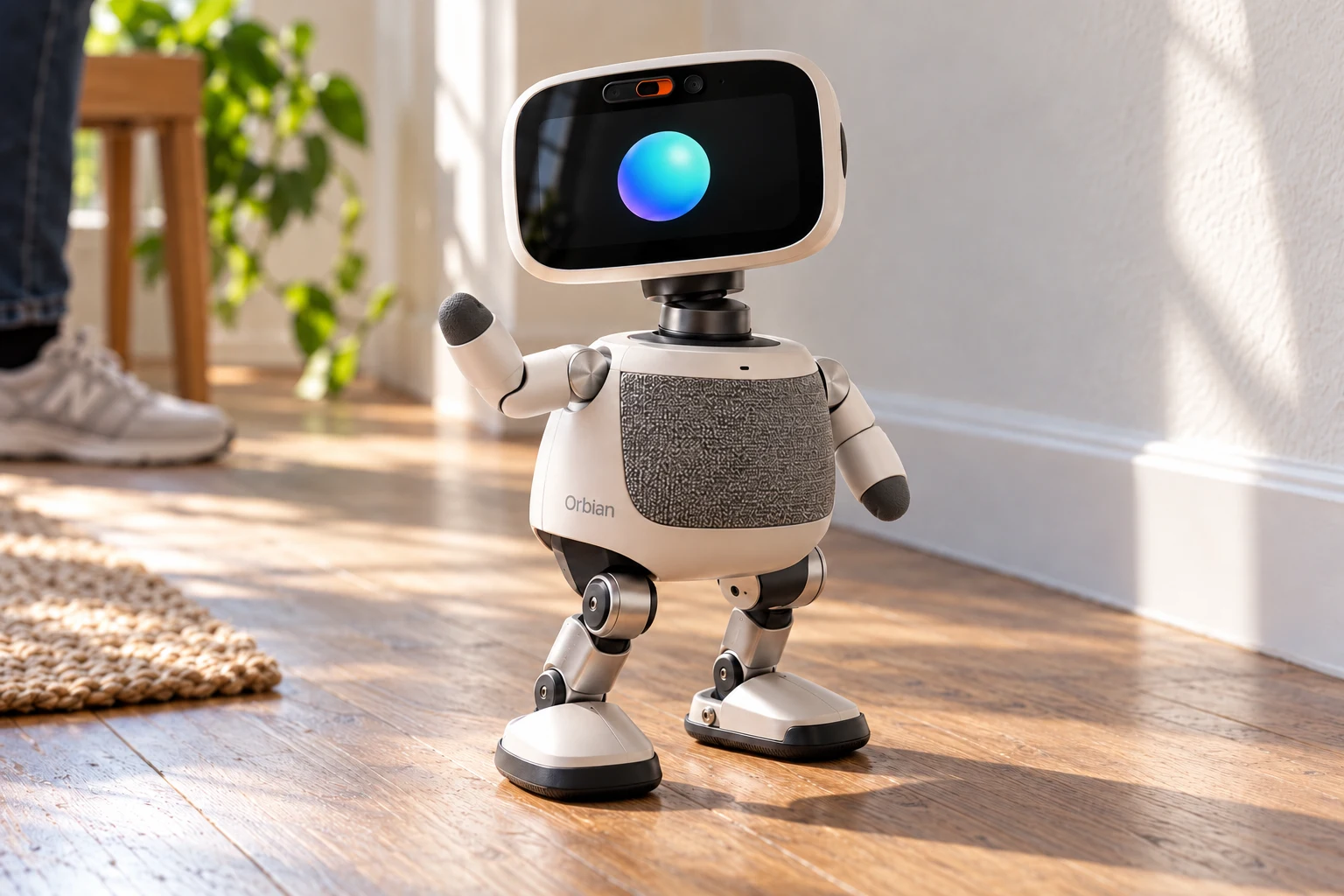
A concept for a physical mini robot with two legs, small expressive arms and Orbi. Designed to explore steps, gestures and interaction in a prepared space.
These are development goals, not features that already exist. Every skill starts in a prepared environment with test criteria.
Explore a short, controlled walk on flat surfaces. Balance, stopping and recovery are studied first in a prepared environment.
Propose greetings with its small arms, head gestures and turning toward an authorised interaction. The arms are meant for expression, with no confirmed carrying or manipulation ability. A gesture communicates a system state, not a real emotion.
Develop behaviours in simulation and test them on the prototype. Voice commands map to validated skills, not to free, unlimited movement.
By voice or on the screen, just like Orbi in Orbian OS.
It plans the task and shows you what it will do before moving.
Moving something physical is a red action: it’s confirmed with a click. Voice is never enough.
Movement limits and the stop live outside the AI. The language model doesn’t drive the motors.
Two articulated legs, support feet, short rounded arms and posture sensing as the design direction. Geometry, actuators and environment sensing will be chosen and tested on the prototype.
The proposal combines Orbi and an adapted Orbian OS with an independent controller for balance, limits and stopping. Hardware compatibility still has to be validated.
A display with the official orb, a speaker and a physical capture switch are proposed. Local models, computing and integrations depend on the final configuration.
First behaviour to explore
Prototype environment
We don’t publish payload, battery life, speed or precision figures until a prototype measures them. Nor do we use figures from other brands’ robots.
No. Orbian Mini is a concept in research: there are no sales, reservations, price or date. If you’re interested, let us know and we’ll keep you posted.
Orbi plans and shows you the task, but movement limits and the stop are applied by an independent controller. The language model doesn’t drive the motors directly.
In the current design, moving something physical is an Orbian red action: it needs your click and voice alone is never enough.
It’s planned to check and run the Orbian Domotic scenes you authorise, with the same permissions as in Orbian OS.
There’s no manufactured and validated Orbian robot yet. The images are concept designs generated with AI.
Tell us you’re interested and we’ll keep you posted on progress. It isn’t a reservation or a commitment to buy.

Automated guide
Popular topics
This chat does not send or store your messages. Please do not include personal data.